
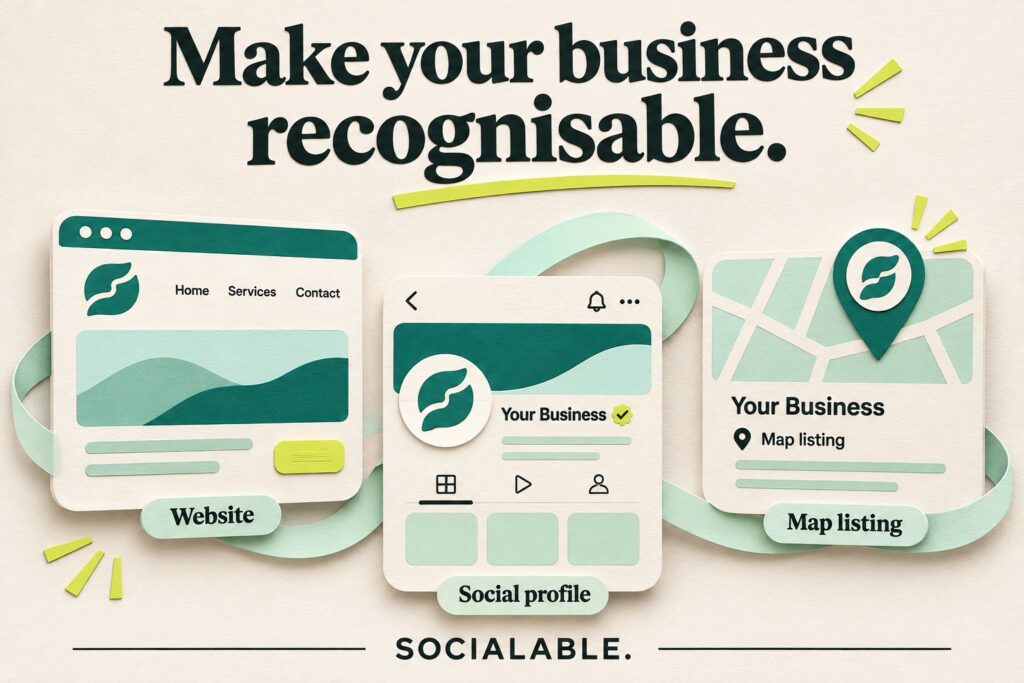
Someone sees your work on Facebook, searches for your business and opens your website. Recognition should carry through that journey. The name, description and examples should make it clear that they have found the same business and the service they were interested in.
This does not require every channel to look identical. It requires a small set of dependable choices: how you name the business, explain the work, present your identity and show evidence. Start with the places customers already use rather than creating more profiles to maintain.
Write down the facts that should stay consistent
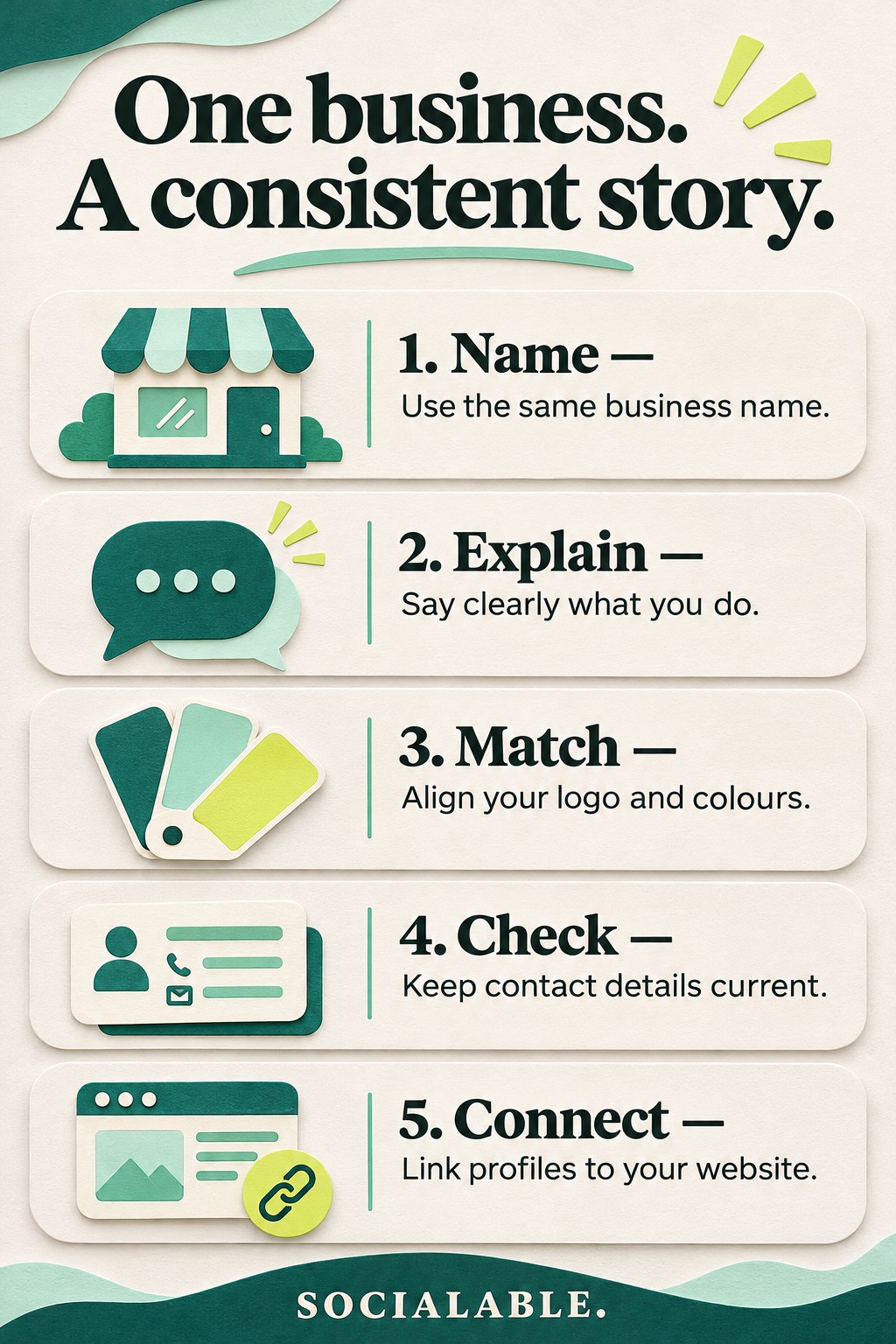
Create a simple reference sheet with your public business name, website address, enquiry details, services, area covered and a short description. Add the approved logo files and the colour choices you actually use. Give the sheet to anyone updating the website, designing posts or managing listings.
Distinguish an outdated fact from a legitimate difference. A profile may allow fewer words than your homepage. A directory may need a particular category. The underlying description should still be recognisable, even when the format changes.
If the business has changed its name or stopped offering a service, make a list of the places that need updating. Do not just change the homepage and assume customers will never encounter the old information.
Explain the work in a sentence a customer could repeat
Start with what you do, who it helps and any useful boundary such as the type of property or area you serve. A broad phrase such as “bespoke solutions for your home” tells a visitor very little about the job you can do.
For an illustrative joinery business, “We design and fit storage for awkward spaces in Brighton and Hove” gives a customer a clearer idea. The wording would only be appropriate if the service and coverage were true. Specificity helps the right person recognise a fit; it also helps someone with a different job move on.
Test the sentence aloud. Would you use it when answering the phone? Could a customer use it to recommend you? Replace internal terminology with familiar words, while retaining the specialist detail that matters to the decision.
Use the same visual identity at useful points
Check that your logo remains legible as a small profile picture and against the backgrounds where it appears. Keep a suitable compact version for small spaces and a wider version where the layout allows. Avoid squeezing a wide logo into a tiny circle simply because it is the first file you found.
Use a limited, repeatable approach to colours and typography. A recognisable identity is easier to maintain when the person making next month’s post can find the right files and understand the choices. Keep important words in readable text wherever possible, rather than putting every message inside an image.
Make the evidence tell the same story
If you want to be known for a particular type of work, show relevant projects across the places customers visit. A service page about fitted storage should not depend entirely on images of unrelated repairs. A social profile that mostly shows a service you no longer want will create a different impression from your homepage.
Choose one approved project and describe the customer’s problem, an important decision and the finished work. The website can carry the fuller explanation. A social post can focus on one decision, while a relevant listing can use an appropriate photograph and an accurate service description.
Consistency does not mean copying the same paragraph everywhere. Give each location enough context for its reader. Our guide to turning one question into a month of content shows how to adapt a topic without repeating yourself.
Check the journey with someone unfamiliar with you
Ask someone to look at your main profile and homepage, then tell you what the business does, who it works for and how to enquire. Let them answer without coaching. If their answers differ, ask which words or pictures led them there.
This is a practical clarity check, not a formal measure of brand awareness. It can still reveal a vague headline, a confusing service name or a profile that directs people to the wrong page. Repeat the same exercise after the correction.
Fix the points of confusion first
Work in a sensible order: correct inaccurate facts, clarify your main description, replace outdated identity files, then improve the project evidence. Assign each change to the person with access and record where the current files are stored.
Build a review into ordinary business changes. A new service, changed phone number or different coverage area should trigger a check of your main customer touchpoints. A quarterly check is also a useful working habit if several people publish content.
Begin with your homepage and the social profile that produces the most relevant conversations. For a wider review of how your business appears across search, website and social, the Brand & Search Audit identifies the inconsistencies and puts the fixes in order.